Irène Joliot-Curie and Frédéric Joliot
Partners in life and in the lab, the Joliot-Curies were the first to discover man-made, or “artificial,” radioactivity.
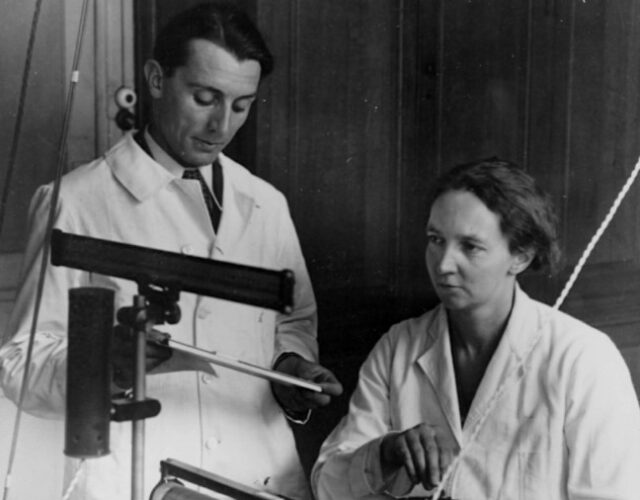
Irène Joliot-Curie and Frédéric Joliot, a wife-and-husband team, received a Nobel Prize for their artificial creation of radioactive isotopes. With their discovery of “artificial” or “induced” radioactivity, radioactive atoms could be prepared relatively inexpensively, a boon to the progress of nuclear physics and medicine.
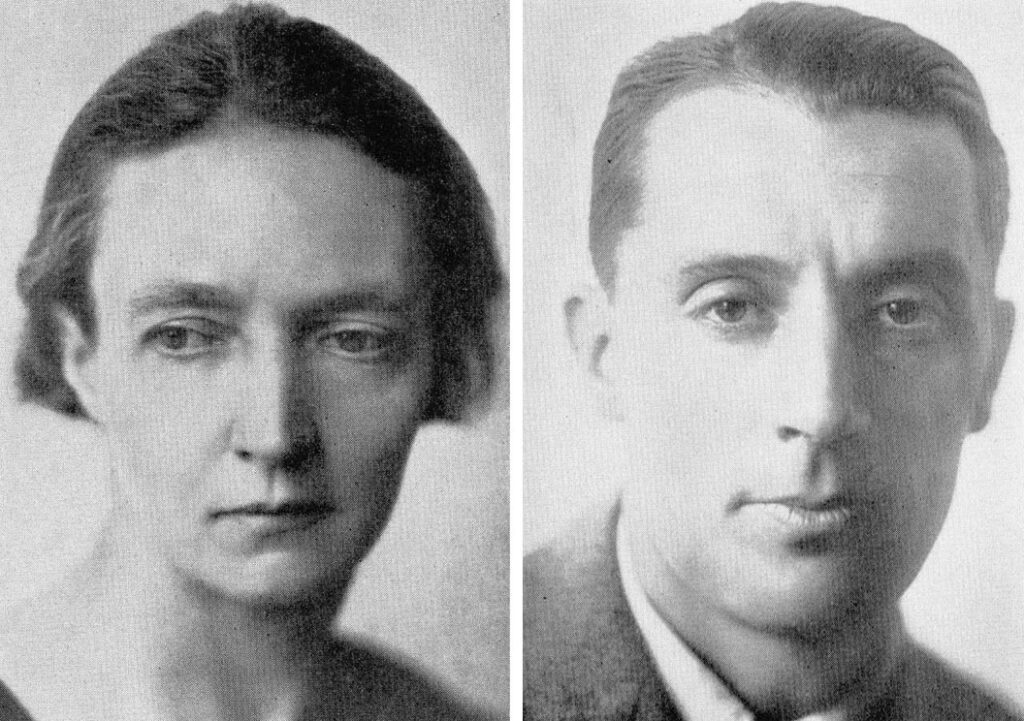
Irène and Frédéric Joliot-Curie.
As a child, Irène Joliot-Curie (1897–1956) had the unusual experience of attending for two years a special school that emphasized science, organized by her mother, Marie Curie, and Marie’s scientific friends for their own children. Irène was still a teenager when she worked with her Nobel Prize–winning mother in the radiography corps during World War I.
After the war she assisted her mother at the Radium Institute in Paris, meanwhile completing her doctorate. She married Frédéric Joliot (1900–1958), a young physicist who had come to work with her mother.
Man-Made Radioactivity
The Joliot-Curies won the 1935 Nobel Prize in Chemistry for their artificial creation of new radioactive elements by bombardment of alpha particles (helium nuclei, He2+) on various light elements.
They correctly interpreted the continued positron emission that occurred after bombardment had ceased as evidence that “radioactive isotopes” of known elements had been created. Up to this point the only way to obtain radioactive elements was to painstakingly extract them from their natural ores at considerable cost.
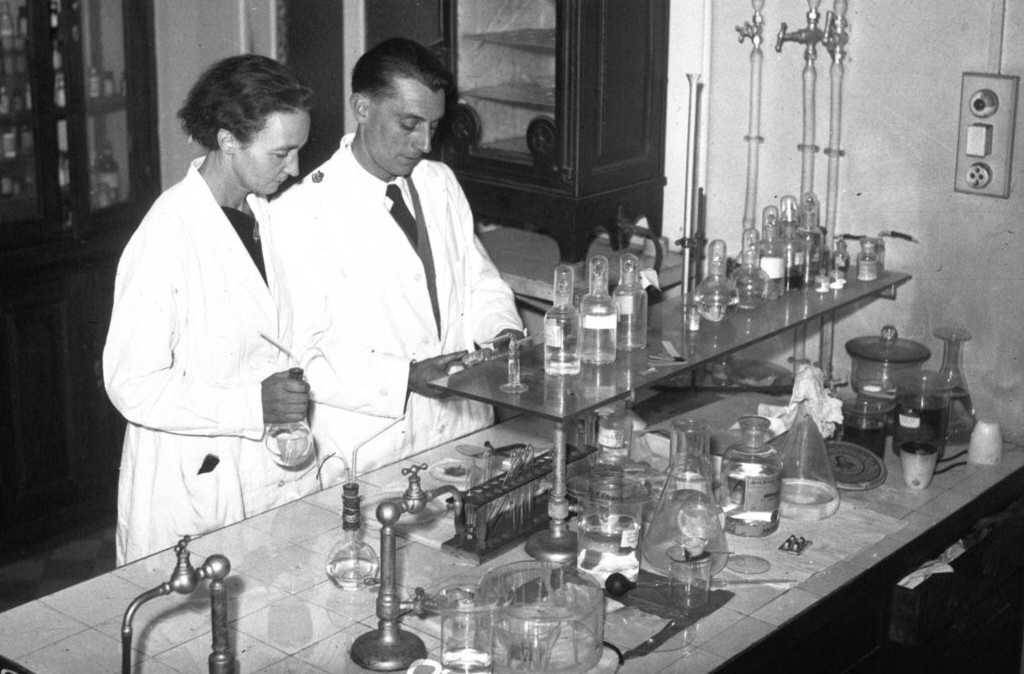
Irène and Frédéric Joliot-Curie in their laboratory in 1935.
With the Joliot-Curies’ discovery, useful radioactive isotopes were now relatively easy and inexpensive to produce, and they rapidly became important tools in biomedical research and in the treatment of cancer.
In its presentation speech the Nobel Prize Committee acknowledged, “The results of your researches are of capital importance for pure science, but in addition, physiologists, doctors, and the whole of suffering humanity hope to gain from your discoveries, remedies of inestimable value.” [1]
The Joliot-Curies were the parents of a boy and a girl, Pierre and Helene, both of whom became scientists—thus continuing a famous scientific dynasty. Irène and Frédéric died in Paris, two years apart.
[1] “The Nobel Prize in Chemistry 1935: Award Ceremony Speech,” nobelprize.org, (accessed August 13, 2015).
Featured image: Irène Joliot-Curie and Frédéric Joliot in the physics laboratory at the Radium Institute in France, 1935. © Association Curie Joliot-Curie.