Robert Burns Woodward (1917–1979) was never far from a cigarette—even in the lab. Woodward’s perpetual smoking presented both a fire hazard (as he worked with volatile solvents) and an ingestion hazard (as toxic substances could contaminate the cigarette and be inhaled). There’s no question that Woodward was a great organic chemist, nor that his accomplishments can inspire students to become the chemists of tomorrow. But given his safety practices, he was also lucky that he was not killed in a smoking-related laboratory accident. Examples from the history of lab safety, like Woodward’s and the ones that follow, remind us that students should focus on the intellectual achievements rather than the safety practices of those who came before.
The eyes are probably more vulnerable to injury in lab accidents than any other part of the body. Today affordable and well-designed safety glasses, goggles, and face shields make eye injuries fairly rare. In the days before tough transparent plastics made eye protection cheap and practical, however, eye injuries were just part of the job. Take Joseph-Louis Gay-Lussac (1778–1850) for instance. Not long after Humphry Davy (1778–1829) discovered potassium, Gay-Lussac began studying the metal. Given potassium’s violent reactivity, an accident was probably inevitable, even for a meticulous experimenter like Gay-Lussac. In 1808 a potassium explosion temporarily blinded the young chemist. His eyesight was never fully restored, which turned out to be a blessing in disguise: the corrective lenses he required afterward protected his eyes from at least one later explosion.
Gay-Lussac was hardly the only chemist to put his eyes at risk in his research. Robert Bunsen (1811–1899) also could have used some eye protection. He had always been a risk taker: he was known for climbing into the mouths of Icelandic geysers on the verge of eruption to measure water temperatures. From these data he developed models to describe how geysers erupt that are still accepted today. For all the danger he faced from the earth’s fury, it was back in his laboratory in Germany that his luck ran out. In 1843, a flask containing cacodyl chloride (C2H6AsCl) exploded in Bunsen’s face, and he permanently lost the use of his right eye.
In his study of arsenic compounds, including cacodyl chloride, Bunsen was nearly killed after inhaling the compound’s dangerous vapors. Today scientists approach the production of dangerous substances in the lab with great caution, using fume hoods to carry away toxic fumes; but this was not always the case. Few stories illustrate this better than the tale of the work to isolate fluorine.
Fluorine is the most reactive of all known elements. Its compounds can be corrosive and explosive, and its fumes can cause inhalation hazards. Today chemists go to great lengths to avoid generating it in the lab. For most of the 19th century, however, scientists were trying to generate fluorine, as the element had never been isolated before. The combination of fluorine’s reactivity and poor safety practices led to a slew of accidents over the decades, some of them fatal.
Humphry Davy was the first to attempt to isolate fluorine. He had isolated chlorine through the electrolysis of sodium chloride (NaCl), and he logically figured that he could isolate fluorine through the electrolysis of analogous fluoride compounds. Davy’s work involved handling dangerous hydrogen fluoride (HF). In an era before fume hoods, he suffered damage to both his eyes and fingernails from the fumes. Davy never did isolate fluorine, as the gas was so reactive that it formed compounds with nearly everything it touched.
Irish brothers Thomas and George Knox took up the chase, and in the process both suffered severe hydrogen fluoride poisoning, which can damage the lungs, heart, kidneys, skin, and eyes. Two other chemists, Paulin Louyet and Jérôme Nicklès, died in their attempts to isolate the gas. In the 1860s the English chemist George Gore caused several explosions when the fluorine he produced reacted violently.
Fluorine continued to elude scientists until 1886. In that year the French chemist Henri Moissan (1852–1907) used electrolysis to produce elemental fluorine from a solution of potassium hydrogen fluoride (KHF2) and hydrogen fluoride. To keep the fluorine from reacting he used newly available refrigeration techniques, which chilled his reaction mixture to –23ºC. This trick allowed him to isolate and identify fluorine, a feat for which he received the 1906 Nobel Prize in Chemistry. Moissan certainly would have inhaled fluorine and hydrogen fluoride fumes during the course of his work, but he managed to avoid becoming a casualty of the halogen—not through any effective safety measures, but by preemptively dying of appendicitis just two months after his Nobel award ceremony.
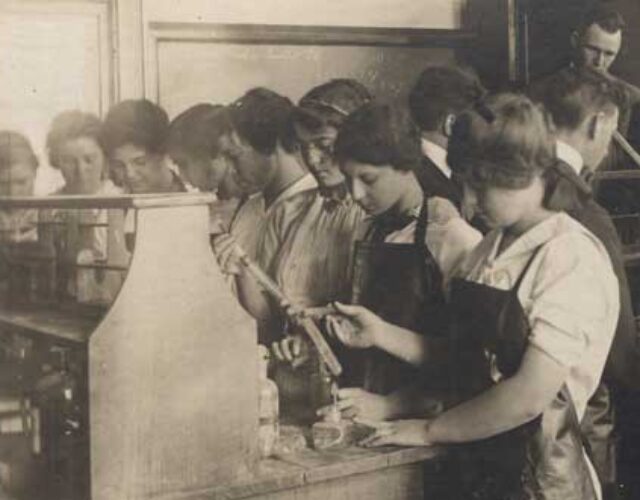
Working without eye protection or fume hoods and casually producing violently reactive substances were just some of the dangerous things chemists used to do. In addition, pipetting by mouth, tasting chemicals, and washing hands with benzene (C6H6), now known to be a carcinogen, were once common practices. To students and practicing chemists alike, the very real results of the lax safety standards of days gone by should be powerful reminders that a lot of pain and hardship can be avoided by following the simple rules of lab safety and using common sense.