The American Institute of Chemical Engineers (AIChE) was established by a committee of chemists and engineers in 1908 during a period of industrial renaissance in the United States. At the turn of the last century the major world powers were anticipating the great need for engineering expertise both at home and throughout their empires; to be competitive in the world markets required major attention to engineering and technology. A telling sign of this competition was the appearance of several technologically sophisticated and nationalistic super ocean liners launched between 1900 and 1912: the Mauretania, the Deutschland, the France, and especially the Imperator, whose impressive structure, speed, and opulence represented a momentary display of German superiority. The founding of AIChE in 1908 was important not only for the professionalization of chemical engineering, but also because it represented the beginning of American technological dominance in the world stage of the 20th century. On 12 June 2008 AIChE celebrated its centennial in Philadelphia, the site of its original meeting 100 years ago.
The European Crucible
The chemical industry had a central position in the changing industrial world of the late 19th century. This industry did not hatch fully grown; it was based on nearly a century’s worth of scientific advances in the universities—particularly German universities.
In the beginning of the 19th century, scientific conditions were such that the study of chemistry was flourishing in Germany. Prominent among all scientists, Justus von Liebig (1803–1873) may be considered a major force in 19th-century chemistry, not only because of his seminal research achievements but also because of his great gift as an educator. In 1825 Liebig established a small chemistry laboratory at the University of Giessen, a town 35 miles north of Frankfurt, Germany. Over the next 30 years a large number of famous scientists would be educated there, including August Kekulé, August Wilhelm Hofmann, Adolphe Wurtz, and Charles Gerhardt. By the second quarter of the 19th century, three major chemistry laboratories at the universities of Giessen, Göttingen, and Heidelberg were producing a number of outstanding organic and physical chemists. All of them did imaginative research that led to new production methods of important chemicals and nourished the German, European, and—indirectly—American industry. Students educated in these laboratories would in turn establish laboratories elsewhere, including the United States.
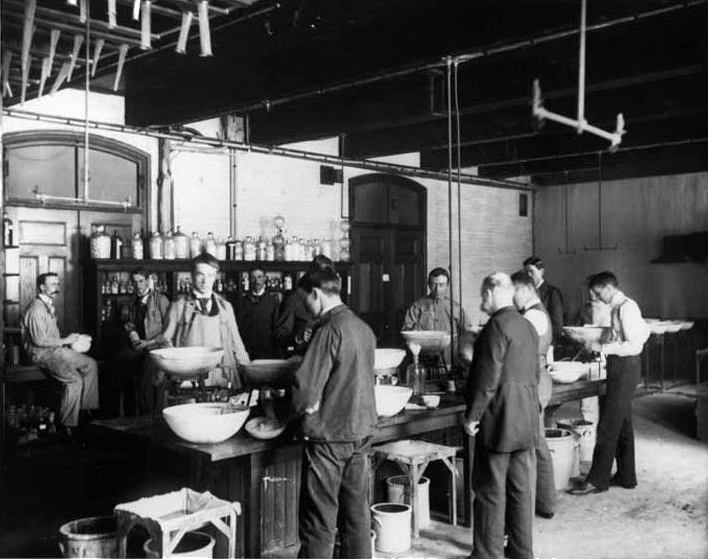
What set Liebig and his students apart from other university chemists of the time was an interest in applying their fundamental discoveries to the development of specific chemical processes and products. Hoffman’s aniline dye process is only one of many such processes developed between 1840 and 1880 in Germany.
In 1848 the political revolution that had started in France swept eastward across the Rhine, overthrowing established authority in Germany and giving central Europe a taste of liberal reform. The Industrial Revolution, made possible by chemistry, proved immensely profitable on the one hand, but on the other it also created new factory environments with deplorable working conditions. One result of the political changes in 1848 was an attempt to revise industrial processes with an emphasis, though primitive, on safer and more efficient methods. These were the circumstances from which the field of chemical engineering would emerge in the mid-19th century.
Creating a Curriculum
Despite the developments in German universities and industry, education in chemistry and chemical engineering had not been formalized. Students obtained at best superficial knowledge about the new industrial chemical processes in their chemistry courses. The operation of distillation columns, filtration units, and the like was taught in so-called technical schools, not in universities. The Technical University of Braunschweig, for instance, soon offered “industrial” courses, but in the eyes of Liebig’s academic descendants at Göttingen, Heidelberg, and Berlin, it was not to be considered a university.
By the end of the 19th century, competition among Great Britain, Germany, and the United States for industrial chemicals had become rather fierce, and chemical engineering expertise was in high demand. The first course in chemical engineering was offered by an unknown industrial prospector from Manchester, England, named George E. Davis, who decided to transfer his vast knowledge from years of inspecting chemical plants in the industrial regions of England to the classroom. In fall 1887 he gave a series of 12 lectures that were later published in Chemical Trade Journal. The next year Lewis M. Norton (1855–1893) of the chemistry department of the Massachusetts Institute of Technology (MIT) offered a new course in chemical engineering. The course material was taken predominantly from Norton’s notes on industrial practice in Germany, which at that time had probably the most advanced chemical process industry in the world.
When Norton died in 1893, Frank H. Thorpe (1864– 1932), an MIT graduate who had earned a doctorate from the University of Heidelberg that same year, took responsibility for Norton’s course. Five years later he published what may be considered the first textbook on chemical engineering, entitled Outlines of Industrial Chemistry. This textbook made mention of the chemical treatment of biological by-products, a very faint indication of early biotechnology processes.
Although Norton and Thorpe pioneered the teaching of chemical engineering in the United States, it was Arthur A. Noyes (1866–1936) and later William H. Walker (1869–1934) who helped bring to the discipline the respect it would eventually enjoy within the engineering curriculum. Noyes established the Research Laboratory of Physical Chemistry at MIT in 1903 before making his mark in 1913 by transforming what was then Throop College into the California Institute of Technology. Walker, who had received his doctorate in 1892 at the University of Göttingen with future Nobel laureate Otto Wallach, was hired as an instructor at MIT in 1902. Under Walker’s leadership, MIT’s Division of Applied Chemistry (as it was then known) flourished, and the establishment of its Research Laboratory of Applied Chemistry followed in 1908. In his institution-building work Walker was assisted by Warren K. Lewis (1882–1975), for whom the prestigious AIChE teaching and education award is named. He left a deep impact not only through his series of industrial consultancies and attempts at profession building, but also through his emphasis on practical teaching.
In England, during the same period, Davis proceeded with the publication of his Handbook of Chemical Engineering (1901), which was revised and published in a second edition of over 1,000 pages in 1904. Davis’s textbook was particularly important because it introduced the notion of “unit operations,” although the term itself would not be coined until 1915 by Arthur D. Little at MIT. As developed by the two men, “unit operations” referred to the idea that all chemical processes can be analyzed by dividing them into distinct operations, such as distillation, extraction, filtration, and crystallization, all of which are governed by certain principles. More than anything, however, Davis was responsible for coining the term chemical engineering to describe this new engineering area that addressed problems of the chemical industry.
In the United States, MIT is considered the first university to have offered, in 1888, a four-year curriculum in chemical engineering, in 1888. Other universities soon followed MIT’s example: the University of Pennsylvania (1894), Tulane University (1894), the University of Michigan (1898), and Tufts University (1898). Each of these four-year programs in chemical engineering were housed within the chemistry department.
The Institution of a Profession
In this climate of international competition and academic excitement the young field of chemical engineering found the right ground to thrive in. In 1903 a specialized publication appeared. The Chemical Engineer was not exactly a scientific journal, but it included practical articles written by practicing industrial chemists and engineers, including William Walker. By 1905 this magazine had a circulation of more than 1,600, including about 570 chemical engineers.
By 1904 tensions were bubbling up among members at American Chemical Society (ACS) meetings about the relationship between chemistry and chemical engineering. At that year’s meeting Hugo Schweitzer, a prominent New York industrial chemist, declared himself “absolutely against the introduction of chemical engineering in the education of chemists. ”In the same meeting M. T. Bogert agreed with Schweitzer, saying that progress in “technical chemistry” was best achieved in research laboratories by researchers without engineering training. But the engineers found a defender in Milton C. Whitaker, a professor of chemistry at Columbia University, who argued that a chemist was “generally not the man who is capable of transmitting from a laboratory to a factory the ideas which he has developed ”because he lacks education “in the engineering branches.”
The controversy soon spurred action. Three years later a group of 12 chemists and engineers met at the Chalfonte Hotel in Atlantic City to discuss the future of their profession. At the end of their discussion they formed the so-called Committee of Six to explore the “possibility of forming a chemical engineering organization.” The Committee of Six represented the core of what would become AIChE’s leadership, which included Walker as well as three men who would go on to become presidents of the organization: Arthur D. Little (1919), Charles F. McKenna (1910), and John C. Olsen (1931). Discussions continued for almost six months after the meeting, but it was finally decided that an organizational meeting was the next step.
The Committee of Six, joined by 15 other chemists and chemical engineers, held its next meeting in January 1908 at the Belmont Hotel in New York. Once again Bogert, by this time president of the ACS, raised the objection that his organization already served the needs of practicing industrial chemists. Nevertheless, the Committee of Six stood firm and decided to form a new organization dedicated to chemical engineering. On 22 June 1908 the first meeting of the AIChE convened at the Engineer’s Club of Philadelphia. According to minutes recorded by William Meade, “enthusiasm ran high” among the 40 men in attendance.
As originally envisioned, one of the primary goals of AIChE was to raise the professional status of the 500 or so chemical engineers then working in American factories and chemical manufacturing plants. Partly as a way to placate the ACS and partly in an attempt to make membership exclusive—and therefore prestigious—the AIChE initially adopted strict membership requirements: members had to be at least 30 years old, be currently engaged in “applied” chemistry, and have either 5 or 10 years of industrial experience, depending on whether the applicant held a science degree. These requirements kept membership small (well under 1,000) through the first two decades of the organization’s existence.
In those days the training of chemical engineers was a subject of much debate in AIChE meetings. Whitaker, an influential professor of chemical engineering at Columbia University and an early president of AIChE (1914), expressed his views on the training of chemical engineers as follows: “The chemical engineer works in the organization, operation, and management of existing or proposed processes with a view to building up a successful manufacturing industry . . . His fundamental training in chemistry, physics, mathematics, etc., must be thorough and must be combined with a natural engineering inclination and an acquired knowledge of engineering methods and appliances.” He continued by giving a description of the types of courses that should be taught, which he classified as courses for “fundamental training” (chemistry, physics, mathematics), “associated training” (electrical, mechanical, civil, and general engineering, and business economics), and “supplementary training” (laboratory and administration courses). For Whitaker it was important that a distinction be made between the education of a chemical engineer and that of an industrial chemist. The chemical engineer would study both chemical processes and unit operations, while the industrial chemist traditionally learned specific procedures for producing bulk quantities of feedstock chemicals. His views affected his graduate students, prominent among whom was Eugene E. Leslie, who would later teach at the University of Michigan.
Over the course of the 20th century, chemical engineering gradually developed a specific disciplinary identity, focusing first on unit operations, then adding applied thermodynamics, chemical-reaction engineering, applied mathematics, and computer science. By the mid-1970s, researchers realized that chemical engineers could contribute significantly to areas outside of the core of classical chemical engineering, including interdisciplinary areas such as the biochemical and biomedical sciences and materials science. Today chemical engineers are leading the way in sustainability, nanotechnology, high-performance materials, and electronics manufacturing.
The establishment of AIChE in 1908 gave shape to the dreams of the “converted chemists” who were calling themselves chemical engineers in the face of opposition from employers as well as professional colleagues. After a century of growth AIChE is unquestionably the world’s leading organization for chemical engineers, with more than 40,000 members in more than 90 countries and more than 100 local sections. Now, in the beginning of the 21st century, chemical engineers’ contributions remain critical not only to the global economy, but also to modern life.