The June air was stifling. But in the Royal Society’s steeply raked amphitheater London’s fashionable men and women, scientists and laymen, crowded the benches and gallery to watch Humphry Davy, the celebrity chemist, present his latest scientific findings. The previous year at the Royal Society’s prestigious Bakerian Prize lecture, Davy had tossed a nugget of metallic potassium into a flask of water, where the lump skittered around the surface of the water before exploding in lavender flames. Expectations for the June lecture were high. The crowd leaned in, anticipating another colorful, if not explosive, performance. With his lively demonstration of electrolysis using a sizable voltaic pile, Davy did not disappoint.
The year 1808 was an important one for Humphry Davy. In that year two centuries ago, Davy discovered five elements: barium, calcium, boron, strontium, and magnesium. He delivered the news of his discoveries to rapt audiences in two captivating lectures—the first in June and another in December—that marked stepping stones in his climb to an apex of scientific and social celebrity status in London. But while Davy enjoyed his celebrity, he also bore gossip, speculation, and criticism as an outsider.
Davy’s 1808 discoveries depended on his use of and research into the burgeoning field of electrochemistry, the study of electricity’s effect on chemical reactions. As a young researcher at the Bristol Pneumatic Institute, Davy had caught the fever of excitement over Count Alessandro Volta’s 1800 paper describing what came to be known as the voltaic pile, a sandwich of a damp cardboard disk between two metal disks that generated a weak but continuous charge. Young Davy immediately began to study and experiment with voltaic piles, making batteries out of them, and using the electrical charges to separate elements from their compounds. Davy had contributed to the field by discovering that electricity itself was caused by chemistry. By the time he arrived in London in 1801, Davy had written six papers on his experiments in electrochemistry. In 1807, using electrochemistry, Davy isolated the metals potassium (from caustic potash, now known to be potassium hydroxide [KOH]) and sodium (from caustic soda, now known to be sodium hydroxide [NaOH]). In 1808 he isolated four of the alkaline earth metals from several mineral mixtures.
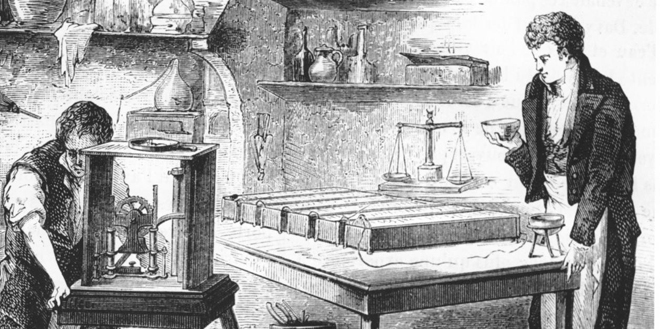
Davy’s electrolytic apparatus was simple in concept: a battery was connected to metallic electrodes that were dipped into a liquid containing the compound that Davy wanted to decompose into its elements. At first, Davy tried to dissolve various compounds in water, but the water was electrolyzed into hydrogen and oxygen, leaving the investigational compound intact. So Davy melted the minerals he was studying and then alloyed them with mercury before passing the electric current through them. The molten compounds bubbled when the current passed through, producing small clumps of silvery metals on one electrode and liberating gaseous oxygen on the other. The electrodes themselves were inert and did not react chemically with the electrolyte. Davy extracted pure barium from a substance called “baryte,” which may have been barium oxide (BaO) or barium sulfate (BaSO4). From “lime,” or calcium oxide (CaO), also known as quicklime, he prepared calcium. To isolate strontium he used “strontites,” which may have been a pure strontium oxide (SrO) or the strontium ore from the Strontian region of Scotland, composed primarily of strontium sulfate (SrSO4). Davy’s magnesium was isolated “magnesia,” or magnesium oxide (MgO).
Experiments as Entertainment
The late 1700s had witnessed the birth of the public scientific lecture, and by 1808 it had become a popular source of entertainment for London’s middle class and elite. Curious men and women would flock to lecture halls to watch as scientists demonstrated the latest discoveries about the properties of electricity, chemical elements, air, and gases. The demonstrations produced sparks, explosions, and unusual odors, all guaranteed to excite the audience. Davy was an expert at public demonstrations, showing off his own extra-ordinary discoveries and a flare for the theatrical that kept his audience riveted to their seats—and kept them talking about him long after they’d left the lecture hall.
For his June 1808 lecture Davy carted one of the Royal Institution’s enormous 600-plate voltaic batteries into the hall to demonstrate electrochemistry for the crowd. Stored in flasks, the molten fluid shimmered in the sunlight, and when the battery was connected to the electrolytic cell, the sudden appearance of metal electroplating one electrode and oxygen effervescing from the other must have seemed like magic.
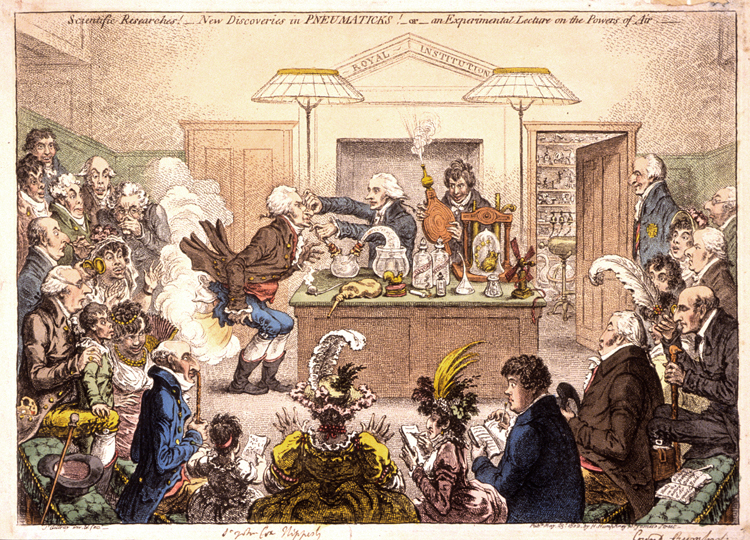
Ladies in the audience twittered at Davy’s fireworks and surreptitiously took notes. Aristocrats preened and even took turns standing in as Davy’s assistant. He was revered by the audience as a scientific wunderkind. Davy was at the top of his game.
But there was another element to his celebrity. Davy was an unlikely star of the Regency period. His humble country beginnings, some early scientific missteps, and a youthful association with political radicals made his London celebrity and aristocratic patronage suspect. He was perceived by some London conservatives as a pretentious social climber, who turned his back on early loyalties in order to curry favor with the Royal Society’s elite. Davy wore rustic clothing, pitched his theatrics toward the women in his audience, and seemed to aspire to a social class to which he did not belong; all this earned him the label of a dandy and a fop. And while the general public revered him for his scientific accomplishments, he was often criticized by the aristocratic and scientific elite.
A Self-Starting Student
Most scientists of the age were formally educated men of independent wealth. Antoine-Laurent Lavoisier, whose chemistry textbook inspired many of Davy’s early experiments, was a wealthy French nobleman who attended the Collège Mazarin and the University of Paris. Joseph Banks, who served as president of the Royal Society when Davy presented most of his Bakerian lectures, was born into a wealthy family, owned country estates and lavish town houses, and attended Eton, Oxford, and Christ Church, where he privately paid honoraria for lecturers with whom he wished to study. In contrast Davy’s parents, though from respectable families, were middle-class, and his cobbled-together education, first in Penzance and later in Bristol, was rather informal.
As a child Davy was given some formal education, but his desultory studies were largely left to chance. He spent some of his childhood as a ward in the home of John Tonkin, a family friend and surgeon-apothecary, whose shop was a source of the chemicals that Davy regularly pilfered. He created firecrackers using tobacco pipes and teacups as vessels and painted phosphorescent figures on the walls to scare his sisters. Full of mischief, with a penchant for explosions, he was a born chemist.
At age 16, shortly after the death of his father, Davy set out on a course of self-education, and with Tonkin’s help found an apprenticeship with Bingham Borlase, an apothecary in Penzance. In addition to writing poetry and reading up on history, theology, philosophy, and metaphysics, Davy began performing basic chemical research and reading Lavoisier in the original French. He advanced quickly and wrote a manuscript detailing his theories on the material makeup of light. The manuscript expounded on Davy’s “phosoxygen theory,” which proposed that oxygen gas consisted partly of light, and that light itself was made of minute particles. Such a manuscript was a great accomplishment for an apprentice apothecary in backwater Cornwall with no university training, one who had never witnessed a scientific experiment being designed or performed.
Full of mischief, with a penchant for explosions, Davy was a born chemist.
Although Davy’s education was informal, he began to attract attention and respect from the local academic and social elite. While still an apprentice he met the Sheriff of Cornwall, Davies Gilbert (born Davies Giddy), an Oxford graduate who would later succeed Davy as president of the Royal Society. Impressed with Davy’s intelligence, Gilbert granted Davy the use of his private library and introduced him to scientists, including Thomas Beddoes, another former Oxford academic. When he met Davy, Beddoes was establishing the Pneumatic Institute, an experimental hospital in Bristol, to study the therapeutic effects of the local “airs” and various gases in the treatment of disease. Of particular interest for Beddoes (and Davy) was nitrous oxide, which many believed spread disease. Others thought it a panacea.
The Bristol Set
Thomas Beddoes was a learned scholar with a streak of political radicalism. While a chemistry reader at Oxford, he had all-too-publicly sympathized with the aims of the French Revolution. He promulgated its revolutionary ideals by authoring antigovernment pamphlets, even after the gruesome details of the Reign of Terror and its hungry guillotine became known, thus earning himself a reputation as a Jacobin. Beddoes removed to Bristol after the British Home Office had suggested to Oxford that his employment was unwise. In addition to founding the Pneumatic Institute in Bristol, Beddoes associated with other known Jacobins there, such as the Lake Poets Samuel Taylor Coleridge and William Wordsworth.
Beddoes was much taken with Davy and his experiments on light and heat; he read Davy’s manuscript and soon offered him a job. With no formal education, Davy became a researcher at Beddoes’s Pneumatic Institute in 1796 at the age of 18.
Davy’s research with Beddoes marked the beginning of his fame and his notoriety. At the Pneumatic Institute Davy lectured about the properties of the gases he isolated, and he showed promise early as a dramatic and compelling lecturer. Through his theatrical lectures and his association with prominent citizens, Davy became known among Bristol society.
One of Davy’s early acquaintances was Robert Southey, another of the Lake Poets. Through Southey and Beddoes, Davy later met Coleridge and Wordsworth. He isolated promising gases in his laboratory, especially nitrous oxide, and in the great 18th-century tradition, tested their effects on himself and his friends. Coleridge and Southey, among many others, allowed themselves to be used as drunken human guinea pigs to explore the effects of nitrous-oxide intoxication, and Davy coined the term laughing gas to describe its delights.
In early 1799 Beddoes published a collection of papers that included Davy’s adolescent experiments on light and heat from his apprentice apothecary years in Penzance. The experiments, though intelligent in design, were abysmal in execution, and his conclusions derived more from passion than from scruple. In this publication Davy triumphantly concluded that his phosoxygen theory explained the blue color of the sky, electricity, red color in roses, the aurora borealis, melanin pigmentation in people from Africa, the fire of falling stars, thought, perception, happiness, and why women are fairer than men.
The critics lambasted Davy’s work, tearing it apart for its overreaching conclusions that did not follow from empirical evidence. His theories were mercilessly ridiculed and treated with vitriolic contempt. In addition to the attacks on Davy’s adolescent research, Beddoes’s Pneumatic Institute drew fire. A Tory satirical magazine, the Anti-Jacobin Review, published an attack in verse on the Bristol “Pneumatic Revellers,” mocking Beddoes and Davy’s nitrous-fueled bacchanalia.
Davy was humiliated by the reviewers’ hostile response to his youthful article, but he took the criticism to heart and refined his experimental methods. In 1800 he published another better-received work in which he laid out his analysis of the components of nitrous oxide and apologized for his previous scientific missteps. The ridicule of activities at the Pneumatic Institute had made a fool of Beddoes, but although Davy also took some of the punches, his reputation was not ravaged.
In fact, Davy’s meticulously researched and sober 1800 book on the composition of gases saved his reputation. Despite his scientific overexuberance, his associations with political radicals, his youthful theatrics, and his questionable experimentation at the Pneumatic Institute, Davy was also gaining recognition as an outstanding scientist. After Thomas Charles Hope, a professor of chemistry at the University of Edinburgh, witnessed Davy’s work at the Pneumatic Institute he recommended to Count Rumford, one of the Royal Institution’s founders, that Davy be brought to London to direct the laboratory and become an assistant lecturer in chemistry. In March 1801 the self-educated country chemist arrived in London to take on Europe’s scientific and social elite.
Moving Up in London
Davy’s reception in London was mixed. The London aristocracy was not immediately receptive to Davy’s seemingly rough, provincial ways. Count Rumford himself was reported to have at first found Davy repulsive.
But the audiences loved him. On 25 April 1801 Davy delivered his first public lecture at the Royal Institution. His excitement over recent advances in electricity made for a clear choice in subject: Davy’s demonstration was on the power of galvanism, or electricity produced by chemical means, to cause movement in the amputated legs of frogs and to catalyze the isolation of metals from aqueous acids. The lecture was a tremendous success. Davy’s flair for the theatrical, coupled with his scientific advances, brought him accolades, and Coleridge attended, adding to the celebrity cachet. Despite a rustic education, radical political associations, and appearances of social climbing, Davy was well regarded at the Royal Society: he was elected a fellow in 1803 and one of two secretaries in 1807.
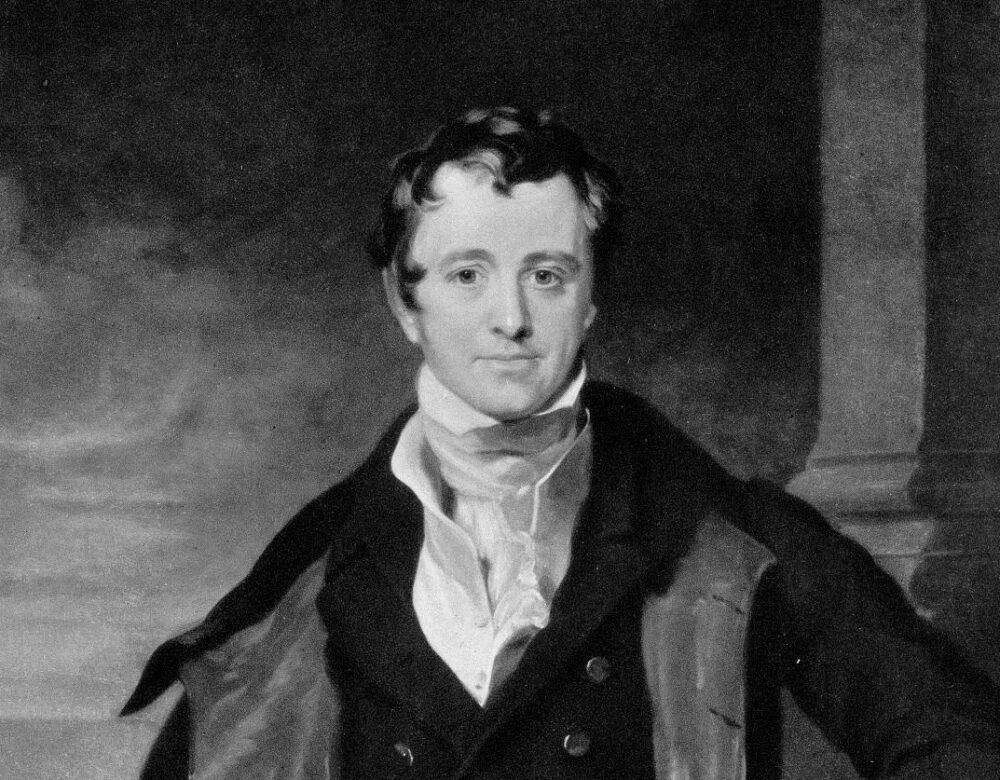
By June 1808 Davy was 29 years old, handsome, well-connected, and acknowledged by his peers and most of fashionable society as brilliant. His notoriety as an abuser of nitrous oxide who held onto his coarse country ways only added to his élan.
Davy’s flair for the theatrical, coupled with his scientific advances, brought him accolades.
Later that same year, two days shy of his 30th birthday, Humphry Davy gave his third Bakerian award lecture in the main theater of the Royal Society. In this lecture Davy announced his discovery of yet another element by the decomposition of boric acid: boron. (That same year boron was also independently isolated by the French chemists Joseph Louis Gay-Lussac and Louis Jacques Thénard.)
An Accomplished and Revered Figure
After 1808 Davy’s celebrity and notoriety only increased. Davy’s lectures were ever better attended, and he gave five Bakerian award lectures at the Royal Society from 1806 to 1810 and a sixth toward the end of his life in 1826.
In 1812 Davy was knighted, gave a farewell lecture to the Royal Institution, and married a wealthy bluestocking widow, Jane Apreece. Davy’s bride was well known in London’s social and literary circles (she was the cousin of Sir Walter Scott), and the marriage was much discussed among fellow socialites. After a few years the marriage was widely known to be acrimonious and was cause for gossip and ridicule.
Also in 1812 a series of laboratory explosions from experiments with nitrogen trichloride caused temporary damage to Davy’s eyesight. He thus hired the young Michael Faraday, a bookbinding apprentice who, like Davy himself, had a great appetite for research but no university training. In 1819 Davy was awarded a baronetcy, an honor unprecedented for a natural philosopher, and in 1820 he became president of the Royal Society, a post he held until he was succeeded by his Cornish benefactor, Davies Gilbert, in 1827.
Coleridge wrote of Davy in 1801 that “chemistry tends . . . to turn it’s [sic] Priests into Sacrifices.” Like Joseph Priestley, another of chemistry’s priests-turned-sacrifice, Sir Humphry Davy eventually left his native England, never to return. He died of heart failure in Switzerland in 1829, at the age of 50. He had become a social celebrity and scientific luminary despite his self-made education and unusual background among London’s academic elite. But he was never entirely able to shed his reputation as a stranger. In fact, Davy’s outsider status—the very fodder for criticism, gossip, and speculation—made him all the more noteworthy to an enraptured public. It may have been the very thing that made him a spectacular star.
Davy’s electrochemical experiments, the decomposition and quantification of minerals and other compounds into their fundamental elements, were vital to the development of electrochemistry, including the work of Michael Faraday in the mid-19th century and Walther Nernst, Paul Héroult, and Charles Hall in the late 19th century. His 1808 lectures unveiling the isolation of barium, strontium, calcium, magnesium, and boron marked a whirlwind moment of theatricality, celebrity, and scientific advance, and an important milestone in the history of chemistry.