
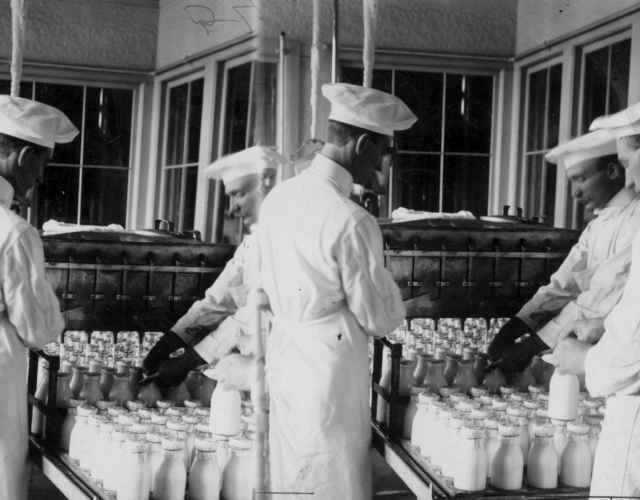
In the 16 March 1907 issue, The Outlook asked its New York City readers, “Should the city cook its milk?” Forty-five years had passed since a French chemist named Louis Pasteur tested the heating process that would eventually bear his name. More than a century later the uncertainty of this question still reverberates through farmers’ markets and online forums as public health officials and consumers battle over safety, nutrition, and taste.
Perhaps no other food has been subject to as much modification as cow’s milk. Milk contains more than 100,000 molecular species: a breathtaking chemical complexity that has led to endless caveats and countless myths. It’s little wonder that the debate over whether and how to alter “nature’s perfect food” is still a heated topic of conversation.
Has the heating process, as its critics suggest, destroyed milk’s natural benefits? Are families playing Russian roulette by spurning the bacteria-killing power of pasteurization, as some public health officials report? The sharp-edged assessments are exceptional not only for their longevity but also for the kernels of truth and hyperbole in each. More remarkable still, the process alternately lauded and demonized for its life-and-death implications germinated within a far more bookish question about the chemical properties of a common crystal.
As a graduate lab assistant at the École normale supérieure in Paris, Pasteur noticed that a crystal named tartaric acid directed polarized beams of light to the right. The organic acid was commonly found in wine barrels and grapes and sold in a milky-white crystalline form. Its alter ego, eventually named paratartaric acid, likewise had been discovered in wine vats and boasted an identical atomic weight and molecular composition. Mysteriously, it was unable to rotate light at all.
In a famous experiment made possible in part by his poorly heated lab, Pasteur used a microscope to hand-separate paratartaric acid crystals and show that they were composed of two mirror-image, asymmetrical compounds (the asymmetry would have been much harder to distinguish under warmer conditions). In solution the ones with a right-handed arrangement rotated polarized light to the right, while left-handed ones rotated light to the left. When mixed, their activities canceled each other out and polarized light appeared unaffected. The observation not only established the field of stereochemistry, but also suggested that right-handed molecules—so designated because of their effect on light—might have left-handed counterparts. Pasteur also suspected that only living organisms could produce such asymmetrical compounds.
Upon his appointment as professor of chemistry and dean of the new Faculté des Sciences at the University of Lille some years later, Pasteur embraced the emerging ideal of applying science to practical problem-solving in industry. Among his new clients in the bustling regional capital was a local distiller struggling to keep his fermented beetroot alcohol from turning sour. The chemist eventually returned to tartaric acid and its easily obtainable crystals for guidance. Soon Pasteur found that the growth of a fermenting agent effectively isolated the left-handed isomer of paratartaric acid, providing a biological basis for what was supposed to be the chemical process of fermentation. To prove that this “ferment” was a living cell and central to alcohol production, Pasteur turned to lactic acid, produced by the defective fermentation of beetroot as an alcohol by-product. In short order he had isolated lactic yeast as the agent responsible for lactic acid production and demonstrated that the yeast cells grow like plants if given the proper food—beetroot sugar, for instance.
Pasteur’s experiments helped refute the notion that fermentation was proceeded by spontaneous generation and laid the groundwork for the germ theory of disease. For Lille’s beetroot distillers the implications were much more immediate. Heating beet juice destroyed the contaminating lactic yeast, allowing it to be reseeded with the desired alcoholic yeast.
A few years later Pasteur was commissioned by Napoleon III to study diseases of wine. With the aid of a microscope, Pasteur observed parasites, fungi, and other microbes. The idea of heating wine to preserve it wasn’t strictly new, but his “pasteurization” method, which he patented and defended aggressively from critics, was the first to provide an explanation for its effectiveness. Heating wine to between 140 and 212 degrees Fahrenheit for a few minutes in the absence of air killed microorganisms that turned wine sour.
Although Pasteur was applauded for his findings, the gifted self-promoter wasn’t immune to charges of opportunism. According to one critic, “he is no more its practical inventor than a man who invents a new theory of the plough, however ingenious, would be the inventor of plowing.” Another criticism began to take hold when some distillers complained that the new heating method sullied the taste of wine and wilted its bouquet. A panel of wine experts, hastily assembled by Pasteur, settled the matter in his favor well enough that his technique soon spread to other vintners. “Pasteur is as popular with the vintners of California as the president of the United States,” one declared.
Spurred by nationalistic pride after the defeat of French troops in the Franco-Prussian War of 1870, Pasteur applied his new technique to the creation of a “beer of revenge” that would top Germany’s finest. In one demonstration he collected beer from Paris’s best cafes and treated some to pasteurization. The treated ones kept indefinitely, while the remainder soon became cloudy and undrinkable. Pasteur shared his knowledge with French breweries to shore up their business prospects, though the best “beer of revenge” was arguably brewed in Copenhagen’s Carlsberg brewery. Benefiting enormously from Pasteur’s heating and yeast-propagation techniques, the Carlsberg brewery commissioned a marble bust to celebrate its new hero.
Germany could take its own measure of satisfaction when agricultural chemist Franz von Soxhlet first suggested using pasteurization for bottled milk in 1886. Soxhlet, a prodigious chemist himself, had already studied the physiological chemistry of milk and devised a new method for extracting and analyzing fat from milk solids, leading to the popular Soxhlet extractor. The chemist’s research also illuminated some key differences between human and cow’s milk and yielded the first description of lactose, as well as the first separation of milk’s major protein constituents.
Germany’s next contribution to the pasteurization movement came in the form of a young doctor named Abraham Jacobi. Later known as the father of American pediatrics, Jacobi left Berlin for New York after being jailed two years for high treason during the political turmoil of the early 1850s. An early advocate of birth control and a socialist who corresponded with Karl Marx, Jacobi fought the notion that raw milk was safe for infants and took up the challenge of convincing a skeptical public that heating milk until bubbles appeared would save lives.
If Jacobi is often credited with bringing pasteurization to the United States, a close friend and fellow German émigré named Nathan Straus was arguably its biggest booster. In 1892 the New York City businessman and philanthropist opened the Nathan Straus Pasteurized Milk Laboratory and soon introduced the first low-cost milk depots for the city’s poor.
And that’s when the controversy really began. By then milk was known to be a fertile medium for a growing menagerie of microbes, or “minute plants,” as some called them. The microbes, in turn, were commonly associated with typhoid and scarlet fevers, diphtheria, and devastating intestinal diseases collectively known as “cholera infantum.” In 1891 the infant mortality rate for New York City averaged 240 deaths per every 1,000 births. Many of those deaths were believed to be due to tainted milk supplies.
Raw milk was also widely blamed for contributing to the “white plague” of tuberculosis, which passed easily from humans to cows and back again. Even finance giant J. P. Morgan had to slaughter a third of his pedigreed herd after a tuberculosis outbreak, despite a doctor’s affirmation that Morgan’s was the “best example in the country of a scrupulously clean, sanitary farm.”
The same could not be said for many other producers. Barns were frequently filthy, and some cows were fed swill left over from whiskey distillation. An 1895 study found that more than one-fourth of 165 herds examined in 17 states harbored tuberculosis. Many distributors were no better. Ten percent of the milk examined by Philadelphia’s milk inspector during July and August of 1891 was condemned because it had been adulterated by some additive or diluted with water.
Meanwhile, confusion reigned over what pasteurization entailed, with some suggesting counterproductive heat treatments of only 130 degrees Fahrenheit for ten minutes. Others suggested 150, 155, 160, or 167 degrees, all dutifully defined as pasteurization. At the other extreme a Medical News article from 1892 reported on the “disheartening” results of feeding sterilized milk to infants at Philadelphia Hospital. Seriously ill children initially recovered. “But later on, most serious and baffling disorders supervened. The children who at first had fattened and thriven on sterilized milk became emaciated and anemic; grave intestinal disorders, which resisted every form of medication and treatment, appeared, and finally, these sterilized-milk-fed children perished of non-nutrition.”
A separate report from the Dairy Commissioner from the State of New Jersey suggested a biochemical explanation. The prolonged boiling of milk, two researchers found, converted soluble albumin to an insoluble, semi-curdlike form not easily digested. Philadelphia Hospital promptly began pasteurizing its milk at 155 degrees Fahrenheit.
By the turn of the century some researchers were concluding that pasteurization at 140 degrees Fahrenheit for 30 minutes or above 149 degrees for 20 minutes was sufficient to deactivate “tuberculous milk.” Loton Horton, president of the Sheffield Farms Company, remained unconvinced and set up his own experiments at one of the seven pasteurizing plants he operated around New York City. After experimenting with time, temperature, and pathogenic tests on guinea pigs, Horton settled on treating his own bottled milk at 146 degrees for 30 minutes, followed by a rapid cooling to 40 degrees.
All the fuss, as well as expense, did not go unnoticed by critics, who argued that the city had neither the money nor the infrastructure to institute mandatory pasteurization, as Straus and Jacobi advocated. Many complained that pasteurized milk featured an unpleasant “cooked” taste and grumbled over the diminishment of its “nutritive qualities.” Others contended that the real menace was lurking in dirty farms and distribution chains and urged a wholesale tightening of inspections. Still others accused the press of grossly exaggerating how often diphtheria and tuberculosis were really introduced into a household by the milkman.
These complaints bear an uncanny resemblance to those still voiced today: pasteurization may kill harmful germs, but it also destroys the properties of milk that resist them. The natural souring of raw milk by harmless bacteria is an important warning about its advancing age. And contamination can easily occur after pasteurization, creating a false sense of security and reducing the attention to cleanliness, rendering the milk all the more dangerous. Most residents agreed that pasteurized milk should be made available to poor children, for safety’s sake, and that excessive sterilization stripped milk of its nutritional value. But by the time The Outlook posed its milk-cooking question in 1907, little other common ground remained.
Nonetheless, the pasteurization movement was gaining steam. In 1909 Chicago became the first American city to enforce a compulsory milk pasteurization law, despite strong opposition at the state level. After vehement back-and-forth editorials, prolonged political maneuvering, and a typhoid epidemic blamed on raw milk, New York’s commissioner of health followed suit in 1914 with the enforcement of a previously adopted ordinance.
Seven years later the city’s infant mortality rate dropped to 71 deaths per every 1,000 births—less than one-third of the rate in 1891. Arguably, other improvements in health and hygiene also played a role in the decline. But the modernization of milk production ultimately settled the matter in favor of pasteurization. By 1938 bulk tanks on farms had begun replacing the ubiquitous milk cans. Pooling milk from multiple sources was becoming increasingly routine, a necessary step to keep pace with rapidly growing demand. But it also greatly increased the risk of contamination and furthered the call—and need—for pasteurization. By the end of 2007 only 4 states still permitted raw milk in their grocery coolers, though another 24 allowed on-the-farm sales.
Today milk-borne diseases are rarely fatal in most developed countries, though many remain on watch lists. Ailments like Brainerd diarrhea and Crohn’s disease have been tentatively linked to raw-milk consumption. Regarding the continuing risk from bacteria in cow’s milk contaminated by urine and especially feces, Cornell University’s Kathryn Boor notes dryly, “What we haven’t been able to do is to get cows to stop defecating.”
The ongoing pasteurization debate, often framed in terms of David versus Goliath, has pitted the Centers for Disease Control and Prevention, the U. S. Food and Drug Administration, the dairy industry, public-health officials, and most scientists against a looser grassroots alliance of farmers, organic-food enthusiasts, and non-profit advocacy organizations like the Weston A. Price Foundation. At its core the battle is all about weighing the potential of heat to kill disease-causing germs against its potential to kill milk’s health benefits and unique taste. Despite their differences, both sides largely agree that pasteurization is no substitute for clean, high-quality milk and that pooling milk from many sources requires heating to thwart the higher risk of contamination. From a 1997 survey of bulk milk tanks in Ontario, researchers calculated a one-in-three chance of finding pathogenic bacteria in raw milk randomly pooled from 10 farms. Nearly 3% of 1,720 samples tested were contaminated with Listeria. A smaller 2006 study found similarly high pathogen counts in bulk milk tanks from Pennsylvania. “I can understand how some people would understand it’s possible to make pathogen-free milk on a very small and very clean farm,” says H. Douglas Goff, a professor of food science at Ontario’s University of Guelph. “But scaling that up, that’s where it falls apart.”
The long-running standard of pasteurizing milk at 145 degrees or more for 30 minutes was set in 1957 to thwart its most heat-resistant pathogen, a highly infectious microbe named Coxiella burnetii that causes Q fever in humans. The dairy industry agreed to tweak the pasteurization process again when, in the aftermath of the 2001 anthrax attacks, a study envisioned the ease with which bioterrorists could taint a portion of the nation’s milk supply with the deadly botulinum toxin. Nonetheless, researchers concede that pasteurization may not kill all pathogenic microorganisms or fully inactivate every toxin.
The question of exactly what does—or does not—happen within milk as the temperature rises continues to confound. One chemical process often associated with heating, known as the Maillard reaction, imparts both the caramelized flavor of crème brûlée and the less desirable “cooked” taste of overheated milk. Also blamed for the decreased availability of the essential amino acid lysine, many of the reaction’s numerous compounds and intermediates have eluded chemists, especially within its latter stages. Some researchers are now investigating whether cysteine hydrochloride and green-tea extracts may block some of those flavor-altering steps, of particular relevance to Ultra-High-Temperature (UHT) pasteurized milk that has been heated to between 275 and 302 degrees for 4 to 15 seconds.
Even during regular pasteurization, milk can lose about 20 percent of its vitamin C content, with lesser damage to other nutrients like thymine, vitamin B12, and lysine. Even so, pasteurization supporters contend that the overall effect on nutrition is minimal—a position strongly challenged by opponents.
But what about milk’s countless enzymes? Lactoferrin—also present in human milk, tears, and saliva and sold as an antioxidant—possesses natural antimicrobial properties. The glycoprotein can adhere to bacterial proteins in milk and prevent them from entering human cells, but it doesn’t discriminate between benign and pathogenic microbes. Scientists also say its modest bacteria-fighting abilities can be easily overwhelmed by heat.
Another enzyme, lipase, can degrade milk fat into a particularly pungent free fatty acid—butyric acid—and turn the milk rancid. Heat inactivation of lipase then actually helps preserve milk. But the temperature found to work best for warding off rancidity is slightly above pasteurization, 170 degrees for 16 seconds—and in any case the fat in milk that has not been homogenized is protected within a membrane-bound fat globule from the lipase’s activity.
More confusion has swirled around a third enzyme called xanthine oxidase. One decades-old theory supposed that increased rates of heart disease could be linked to changes in this enzyme caused by pasteurization or homogenization. Despite a subsequent study showing that the underlying mechanism was badly flawed, the myth persists on many Web sites.
Some raw milk advocates contend that pasteurization also kills benign bacteria that aid in digestion. Many researchers believe these lactic acid–producing bacteria have largely disappeared from farms not because of heating but rather from cooling milk immediately after its collection. As a rule all milk is now chilled to 39.2 degrees Fahrenheit, regardless of whether it is pasteurized. The advent of mechanical refrigeration appears to have discouraged some traditional farm-dwelling microbes while benefiting Pseudomonas, which contributes a bitter flavor to raw milk through the production of proteolytic enzymes. Largely missing are the natural Lactococcus, Lactobacillus, and similar cultures that imparted an acidic or sour flavor to milk as it aged. “The same species of bacteria are now being added from a can instead of from the walls and floors of the old farmstead,” Goff says. And in the absence of that raw-milk modification? “Today, it will go bitter before it goes sour.”
Beyond health and nutrition, taste is the paramount feature cited by many raw-milk enthusiasts. Remarkably sensitive to external influences, milk can seem cowy or fishy, flat or metallic, weedy, putrid, or soapy. It can reek of paint or boiled cabbage or simply smell “unclean.” Each odor—and there are dozens of variants beyond the 15 identified on American Dairy Science Association scorecards—comes with its own potential explanation and accompanying molecules of blame. The 1996 second edition of Food Taints and Off-Flavors reads like a how-to manual for spoiling what some purists describe as a fresh, clean, and slightly sweet flavor.
Pasteurization itself can impart a slightly sulfurous taint, whereas higher temperatures can lead to the “cooked” flavor so scorned at the turn of the century. In milk treated by UHT pasteurization, volatile sulfide compounds can produce a temporary essence of boiled cabbage. These chemicals dissipate and a rich or heated flavor emerges after several days of refrigeration. UHT-treated milk’s stronger cooked flavor may derive from sulfur compounds, methyl ketones, and lactones, though the intensity declines rapidly when the milk is stored at room temperature.
Whether chemistry can help resolve the passionate debates and unfinished studies is anyone’s guess. For some backers of raw milk, or as they prefer to call it, real milk, the best science means leaving milk alone. “It’s intact,” says Rachel Lapp Kellogg, owner of the Lapp Farm Dairy in Cassadaga, New York. “It isn’t taken apart and put back together before human beings eat it.”