Joseph and Étienne Montgolfier were two of sixteen siblings from a prosperous papermaking family in southern France. Jacques-Alexandre-César Charles was an urbane Parisian man of science, well-known for his public physics lectures. In the 1780s the Montgolfier brothers and Charles engaged in a spectacular race to levitate into the sky using gas-powered balloons. Their “artificial clouds,” as one writer described the flying globes, would enthrall the French capital and set off a craze for all things balloon.
The story of the first balloons starts with a classic “Eureka!” moment. As Joseph Montgolfier (1740–1810) later related, he was sitting by a fireplace one day in 1782, thinking about the fortress-like island of Gibraltar, then held by Spain. Watching the sparks and smoke go up the flue, he pondered putting hot air to military use. Steam power had been used since the beginning of the century, and even at this early stage of the Industrial Revolution improved steam engines were working in growing numbers of mines, mills, and factories. What if heated, expanding air could lift some sort of conveyance to carry soldiers for an aerial invasion, just as steam drove pumps and pistons?
To try his notion Joseph constructed a light, angular wooden framework, covered it with taffeta, and burned some paper at its lower opening. It quickly rose up to the ceiling, thrilling the dreamy inventor. Soon he and his practical brother Étienne (who was in charge of calculating size, shape, and lifting power) were creating and testing ever-larger balloons made of pieces of paper-backed cloth fastened together by cords passed through hundreds of buttonholes. After a successful public demonstration near their home in southern France, witnessed by the local assembly, published accounts of the marvel soon reached Paris.
The news excited many in the capital, including Jacques-Alexandre-César Charles (1746–1843). Well-educated and an accomplished musician, Charles was familiar with the actions of gases and owned one of the finest private collections of scientific instruments in Europe. Using these instruments in the popular science courses he taught for paying customers, Charles worked constantly to improve his experiments, believing that visual, concrete demonstrations could explain physical laws. He was thus ideally suited to compete with the Montgolfiers in developing these new flying machines, though initially he aimed only to replicate their endeavors as a contribution to scientific knowledge.
Charles thought at first that the Montgolfiers had used hydrogen gas to lift their balloon, as no other lighter-than-air gas was known at the time, and he did not yet know that ordinary atmospheric air could expand enough when heated to lift such a structure. So he recruited two instrument makers, brothers Anne-Jean and Marie-Noël Robert, to help him generate an immense, unprecedented volume of hydrogen gas. To help pay for this expensive undertaking, naturalist and geologist Barthélemy Faujas de Saint-Fond opened a public subscription, selling tickets for a demonstration with time and place to be announced. Despite such vagueness, the elite of Paris quickly signed up, eager to be among the first to see this daring experiment.
Making Gases Fly
For balloons to truly take off, scientists needed to understand how gases worked. Though still in its infancy, the science of gases was advancing quickly. Inspired by Enlightenment beliefs in reason and progress, 18th-century natural philosophers were seeking to unlock nature’s mysteries, including the properties of air—invisible and untouchable, yet ubiquitous and necessary for life. Realizing that atmospheric air was not a single substance, scientists worked to separate air into its component gases, analyzing and observing the properties of each. Englishman Henry Cavendish had isolated hydrogen in 1766, naming it “inflammable air” for its readiness to burn. In the 1770s Joseph Priestley in England, Carl Wilhelm Scheele in Germany, and Antoine-Laurent Lavoisier in France all contributed to the discovery of oxygen. Priestley called his gas “dephlogisticated air” because it apparently lacked “phlogiston,” the universal component of fire then thought to reside in all combustible substances. In June 1783 Lavoisier proved that water was not an element but rather a combination of hydrogen and oxygen. He was soon able to overturn the dominant phlogiston theory, laying the groundwork for modern chemical terminology and methods. Charles would later make an important contribution to this effort in 1787, when he formulated the law of gases that now bears his name. Eventually elaborated by Joseph-Louis Gay-Lussac, Charles’s law states that under constant pressure the volume of a fixed weight of gas is directly proportional to its absolute temperature—a principle that would prove essential to ballooning.
To make his flying vessel a reality, Charles focused on producing enough “inflammable air” to fill a medium-sized cloth balloon, which was coated with gum in an effort to make it airtight and waterproof. Large quantities of hydrochloric acid were poured into a barrel of iron filings, with tubes and valves to control the resulting outflow of gas. The Robert brothers had invented an ingenious device to speed up the production of hydrogen: a sort of bureau with iron-lined drawers intended to give the acid more surface area of metal to work on. The apparatus did not function properly, however, so the team reverted to using the barrel. Finally, after innumerable technical difficulties and delays, they were ready. On 27 August 1783, just three months after the Montgolfiers’ hot-air demonstration in southern France, the world’s first unmanned hydrogen balloon took off from the Champ de Mars, the capital’s large military parade ground. As a violent storm began, the balloon shot straight up into the sky and was lost from view in the clouds within minutes.
Faujas de Saint-Fond later described the crowd’s reactions: “The idea of a body parted from the earth and voyaging in space had something so admirable and so sublime about it, so far removed from ordinary laws” that all the spectators were filled with enthusiasm. Even the ladies ignored the rain spoiling their elegant dresses and coiffures as they turned their faces to the sky. Less than an hour later the partly deflated balloon landed in a village about 15 miles north of Paris, where peasants, startled by this uncanny apparition from the heavens, attacked it with pitchforks and other tools.
Though Charles had pulled ahead for the moment, the Montgolfier brothers, after arriving in Paris to seek patronage for their project, had won the favor of government officials and King Louis XVI. In August, as Charles was making final preparations for his hydrogen balloon launch, the Montgolfiers were busy constructing a large balloon for a demonstration before the royal family and court at the palace of Versailles. Since no one knew if there was breathable air high above the earth, the brothers and their collaborators decided to send three animals aloft. If the sheep, duck, and rooster survived the journey, then the way would be cleared for humans to fly. On 19 September, after a royal inspection of the balloon and its heating apparatus—a brazier that held burning straw and wool—the vessel took off. The huge crowd of onlookers had an anxious moment when the balloon tipped suddenly and lost some air, but it soon righted itself and floated away, landing gently in a nearby wood after an eight-minute flight. All three animal aeronauts were alive and well.
Now the race was on for the honor of being the first human to fly. On 15 October, Jean-François Pilâtre de Rozier went up in a tethered montgolfière, the name now given to the brothers’ hot-air balloons. The next month saw the first-ever manned free flight, again in a montgolfière. Decorated with royal emblems in gold on a blue background, this magnificent construction, piloted by Pilâtre de Rozier and François Laurent, the marquis d’Arlandes, flew for 25 minutes. Though the balloon turned frequently in the wind, disorienting its passengers, the landing was safe. The marquis even visited Benjamin Franklin that evening to tell of his adventures. The famed scientist and statesman was then serving as Minister Plenipotentiary to France from the young United States. Living at Passy, then just outside Paris, Franklin participated in the city’s wide range of scientific activities and entertainments. He eagerly followed news about the first balloons, and witnessed this ascension and others, sending detailed descriptions to his correspondents abroad. Replying to a skeptic who questioned the utility of the new invention, Franklin was reported to have asked the rhetorical question: “What use is a newborn baby?” Franklin may never have said those exact words, but he did write that balloons “may pave the Way to some Discoveries in Natural Philosophy of which at present we have no Conception.”
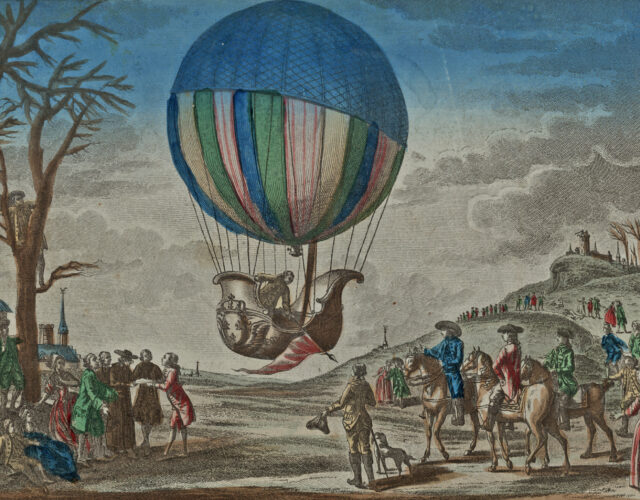
Just two weeks after Pilâtre de Rozier and Laurent rose to the skies in their hot-air montgolfière, on 1 December 1783 the first manned hydrogen balloon flight occurred. Jacques Charles and instrument maker Marie-Noël Robert flew for an unprecedented 2 hours, traveling nearly 30 miles before their charlière descended safely on the Plain of Nesle, north of Paris. A happy group greeted the aeronauts, including two horsemen who had galloped after the balloon.
After this success Charles decided to go aloft again on his own. The balloon, now carrying less weight, soon rose to 9,000 feet. He later reported that “the cold was sharp and dry” at this height and the view spectacular. No human had ever experienced what he saw: the setting sun “rose for me alone, and again appeared to gild the balloon and gondola with its rays. . . . I saw all the rest of nature plunged into shadow.” Unfortunately, a sharp pain in his inner ear distracted him from “this inexpressible delight, this ecstasy of contemplation,” and he released gas from the balloon to return to earth.
Picturing Balloons
Word of the marvelous inventions spread quickly in Paris and abroad, disseminated by journals, pamphlets, books, letter-writers (including Franklin himself), and word of mouth. Prints also documented and publicized the events of early ballooning. In an age before photography, artists could only draw pictures of the ascensions. These artists may have been eyewitnesses, as they sometimes claimed in the inscriptions on their prints, but many copied images by others or reconstructed the scenes from published accounts. Printmakers etched or engraved the drawings onto copper plates, then produced dozens or even hundreds of copies for sale in Paris and beyond. For added visual appeal, colorists hand-painted the prints in watercolor. A new print could be finished just a few days after the event it chronicled, ready for display in shop windows along with dozens of other images portraying the ever-changing diversions of the metropolis.
Since the images needed to appeal to a wide audience, artists emphasized the scenes’ color, drama, and spectacle. Crowds of people often appear in the pictures, all focusing on the central event, with some obviously beside themselves with excitement. The artists tended to show key moments of the ascensions, such as the tense seconds just after takeoff or dangerous mishaps. They also, however, included much information about the construction of the balloons and their associated apparatus, both in the images themselves and in the long captions that sometimes accompanied them. Prints of hydrogen charlières taking off, for instance, nearly always depicted the barrels used to produce “inflammable air.” Even the abandoned iron-lined chest of drawers appears in a print of Charles’s first unmanned balloon flight. Artists of balloon prints may have copied such details from technical diagrams in scientific books and pamphlets (see sidebar), perhaps to add a sense of scientific accuracy to their thrilling pictures.
Did the throngs at the balloon ascensions or the people who viewed or purchased prints of the events afterward, actually learn anything about the science of gases from their experiences? Some men and women undoubtedly did, particularly if they had read scientific books or journals, or attended lectures and demonstrations given by Charles and others. The comparative sizes of the two types of balloons may have provided one clear visual lesson for the curious: the hydrogen used in the relatively small charlières was evidently much lighter than the air lifting the towering, broad montgolfières. But it seems likely that many of the attendees were unconcerned with matters of natural philosophy. Rather, they came for the sheer thrill of seeing balloons and people fly and for the intense communal experience the ascensions provided.
Balloonomania
By the end of 1783 balloon flight was a genuine phenomenon. Ballomanie, or “balloonomania,” had swept the nation, with the vessels displayed not just in books and prints but also used as embellishments for clothing, jewelry, porcelain, curtains, wallpaper, and other decorative arts. Numerous ascensions and landmarks occurred over the next few years: the first female aeronaut, who sang arias over Lyons; the first free flights in Italy, the United States, and England; a flight that lasted 4 hours and traveled more than 160 miles; and the first Channel crossing from England to France.
In 1785 Pilâtre de Rozier, the intrepid copilot of the first manned hot-air balloon flight, planned to traverse the Channel in the opposite direction. For this feat, underwritten by the French government at vast expense, he devised an elaborate Aéro-Montgolfière, a tandem balloon that merged the hot-air and hydrogen systems. Replying to those who warned him of the extreme hazard of such a combination, he argued that the flaming brazier was installed far enough from the flammable gas to avoid the danger of explosion. Soon after takeoff, though, while the balloon was still battling contrary winds near the shore, it caught on fire and crashed, killing him and his passenger.
In their race for the skies the Montgolfier brothers and Jacques Charles had proved that air and gas could lift people far above the earth. The first fatalities of the new era of human flight, however, showed the hazards of relying on such elusive, invisible substances. Nevertheless, balloons continued to rise, eventually developing into airplanes and even spaceships. Once attained, the ancient dream of flying would not be renounced.