
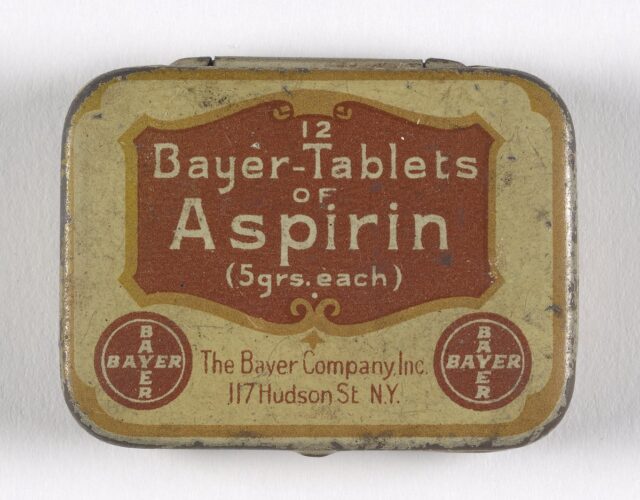
Headache? Fever? Muscle pain? “Take two aspirin and call me in the morning.”
Like most of us, when you experience everyday aches and pains, a bottle of aspirin is probably the first thing you reach for. Yet, while aspirin has been one of the most popular pharmaceutical agents of the past one hundred years, it is actually a synthetic derivative of the natural substance salicylic acid—the associated healing properties of which have been known for millennia.
Salicylic acid is a main component of an herbal extract found in the bark of a number of trees, including the willow tree, and in a number of fruits, grains, and vegetables. As such, salicylic acid—and related salicylates—have long been common components of a normal human diet, functioning as a natural defense against what we consider common ailments today.
The first recorded use of salicylates dates back about 4,000 years to the Sumerians, who noted the pain remedies of the willow tree on early clay tablets. Ancient civilizations in Mesopotamia used the extract from willow trees to treat fever, pain, and inflammation. Both Chinese and Greek civilizations employed willow bark for medical use more than 2,000 years ago, and the Chinese also used poplar bark and willow shoots to treat rheumatic fever, colds, hemorrhages, and goiter. One of the most noteworthy reports of the use of salicylic acid comes from the father of modern medicine, Hippocrates (460–370 BCE). He recommended chewing on willow-tree bark to patients suffering from fever and pain, as well as the use of a tea brewed from willow bark given to women to lessen pain during childbirth. Around 100 CE the Greek physician Dioscorides prescribed willow bark as an anti-inflammatory agent.
Despite this long history, it was not until 1763 that the Reverend Edward Stone of the Royal Society of London conducted one of the first clinical studies on the effects of willow-bark powder by treating patients suffering from ague (a fever thought to be caused by malaria). And approximately 100 years later the Scottish physician Thomas MacLagan studied the effects of willow powder on patients suffering from acute rheumatism, demonstrating that it could relieve fever and joint inflammation.
The chemical investigation of the healing properties of the substance within the willow bark had already begun in earnest, however, during the early 19th century. This investigation was driven in part by Napoleon’s continental blockade on imports, which affected suppliers of Peruvian cinchona-tree bark (another natural source of salicylic acid). In 1828 Johann Büchner, a professor at the University of Munich, isolated a yellow substance from the tannins of willow trees that he named salicin, the Latin word for willow. A pure crystalline form of salicin was isolated in 1829 by Henri Leroux, a French pharmacist, who then used it to treat rheumatism. In the late 1800s large-scale production of salicylic acid for the treatment of pain and fever was initiated by the Heyden Chemical Company in Germany.
The beginning of aspirin as we know it today dates from the same period when Farbenfabriken vorm. Friedrich Bayer and Company, a dye-manufacturing firm in Germany, began to shift its focus from the dye industry to pharmaceutical production. Because the Bayer Company was already well known, it easily developed brand-name recognition as a pharmaceutical maker. The company’s shift to pharmaceutical production coincided serendipitously with a boom in new pharmaceutical agents, making it seem that a new drug was put on the market almost daily.
Just as the medical benefits of salicylic acid had long been known, so too had some of the health issues related to prolonged use of large doses of the drug. Such use often led to gastrointestinal irritation, which could in turn lead to nausea, vomiting, bleeding, and ulcers. In 1895, to counteract such problems, Arthur Eichengrün, the head of chemical research at Bayer, assigned the task of developing a “better” salicylic acid to one of the company’s chemists, Felix Hoffmann. Eventually cited by many as the discoverer of aspirin, Hoffmann approached the task with a personal interest: his father suffered from rheumatism and was taking salicylic acid for it, but he could no longer ingest the drug without vomiting. Hoffmann’s search through the available scientific literature yielded a way to alter salicylic acid chemically through modification of the hydroxyl group on the benzene ring. The key to his discovery, although realized only later, was that this chemical transformation provided a new molecule that the body could absorb without significant gastrointestinal distress. Once ingested, the new molecule was converted back to salicylic acid in the stomach, liver, and blood, thereby providing the desired therapeutic benefits. As such, modern synthetic aspirin can be considered a drug-delivery system for a natural product that has been in medical use for literally thousands of years.
However, this new derivative of salicylic acid did generate some controversy. There was a difference in opinion regarding the potential benefits of acetylsalicylic acid, which would ultimately become a personal dispute as well as a scientific one. Heinrich Dreser, who was responsible for the standardized testing of pharmaceutical agents, disagreed with Eichengrün’s approach to the drug. Eichengrün had distributed Hoffmann’s compound to local physicians, whereas Dreser had no initial interest in supporting the new drug. Ironically, it would be Dreser who published the first article on aspirin, probably because his contract with Bayer provided him royalties for any drug he introduced; Hoffmann and Eichengrün could only gain monetary rewards on patentable compounds. In the article Dreser compared aspirin with other salicylates in an effort to demonstrate that it was more beneficial and less toxic. This work was coupled with human trials whose results were published in 1899 in the journals Die Heilkunde and Therapeutische Monatshefte, showing that aspirin was indeed superior to other known salicylates. On 6 March 1899 the Bayer Company registered the product under the trade name Aspirin and then actively began to distribute the white powder to hospitals and clinics.
According to the theory concerning the origin of the name aspirin, it comes from the combination of acetyl; the Latin Spiraea, the genus of plants to which meadowsweet belongs and which also contains salicylic aldehyde, a precursor to salicylic acid (in German salicylic acid is Spirsäure); and -in, which was a common ending for drug names at the time. Although the company name Bayer has long been associated with aspirin, after World War I, Bayer lost the sole right to use the name aspirin. It was acquired in 1919 by Sterling Incorporated for the then unheard-of price of $3 million, along with Bayer’s U.S. drug properties. Eventually Bayer reacquired the trademark from SmithKline Beecham as part of a wider deal, for the price of $1 billion.
The first tablet form of aspirin appeared in 1900, creating an ease of use that quickly expanded the drug’s recognition among professionals. Medical reports highlighted the benefits of aspirin, and its popularity reflected the already significant use of salicylic compounds, coupled with the fact that this new drug was considerably safer and comparably less toxic. In 1915 aspirin became available to the public without a prescription, making it arguably the first modern, synthetic, over-the-counter, mass-market medicine and a household name around the world.
By providing an easy and inexpensive method to alleviate pain, aspirin began to change the experience and expectations of patients and doctors and ultimately the nature of modern medicine itself. Before the mid-1800s Western physicians had considered pain an essential diagnostic tool, something that aspirin alleviated and thus disguised. Doctors would now have to look to other symptoms.
It was not until 1971 that scientists began to understand how aspirin worked in the body as an anti-inflammatory agent—what is now referred to as a nonsteroidal anti-inflammatory drug (NSAID). John Robert Vane, a British pharmacologist, and his graduate student Priscilla Piper performed pioneering work on aspirin, exploring the effects of the drug on isolated lungs from guinea pigs and studying the effects of substances released from the lungs during severe allergic reactions to aspirin. During these studies the scientists identified two uncharacterized substances, one of which turned out to be a prostaglandin—a hormone-like compound involved in causing diverse effects in the body, including vasodilation, vasocontraction, and sending messages of pain and discomfort to the brain. Piper and Vane later discovered that this prostaglandin had an effect similar to a known enzyme responsible for the contraction of nonvascular smooth muscle. Further studies demonstrated that aspirin minimized some effects of vasodilation response, ultimately leading Vane to consider that aspirin was inhibiting the synthesis of prostaglandins. For Vane’s pioneering work he, along with Sune K. Bergström and Bengt I. Samuelsson, received the Nobel Prize in Physiology or Medicine in 1982.
But how does aspirin affect the production of prostaglandins? In 1976 researchers discovered a particular enzyme, cyclooxygenase, or COX, that is responsible for producing a number of biological mediators, including prostaglandins. Aspirin was found to bind selectively and irreversibly to this enzyme, providing the drug’s beneficial properties. This characteristic differs from that of other well-known NSAIDs (e.g., ibuprofen), which are reversible inhibitors. Further research indicated that there was not one COX enzyme, but three, and that each played a different role in the human body. While one COX enzyme is responsible for the synthesis of prostaglandins during inflammatory reactions, a second is involved in producing prostaglandins that help protect the stomach mucosa. Aspirin affects both enzymes, providing analgesic effects as described, but at high doses sometimes results in stomach irritation. In an effort to separate the two effects pharmaceutical companies have worked hard to develop selective COX inhibitors, such as Celebrex, Vioxx, and Mobic, that reduce inflammation without damaging stomach mucosa. However, a number of issues have arisen with these products, most notably with Vioxx, which recent studies have shown to increase the risk for heart attacks.
Aspirin represents one of humankind’s oldest pharmaceutical agents and continues to be a mainstay therapy for a variety of indications. Like all drugs, aspirin can be toxic at high doses (greater than 150 milligrams per kilogram body weight), but the benefits of aspirin clearly outweigh the risks. We might consider aspirin a true “wonder drug,” as it has been shown to be useful in the treatment of a variety of conditions beyond fever and pain, including prevention of coronary artery disease, heart attack, and stroke. Recent studies suggest that aspirin may also limit the rate of growth and the occurrence of certain types of cancer, including prostate, colon, pancreatic, and lung cancer. While new drugs will continue to treat these and other diseases, aspirin will always hold a significant place in the history of pharmaceutical agents.
This article has been excerpted from Molecules That Matter, a compilation of essays published by the Frances Young Tang Teaching Museum and Art Gallery at Skidmore College and by the Chemical Heritage Foundation (now the Science History Institute).