Media

Archives

Categories

Contributors

Subscribe Subscribe:

Periodic Tabloid

CHF staff and scholars provide a behind-the-scenes guide to activities at CHF, with reflections on science education, provocative explorations of chemistry in the wider world, and much more.


The Real World: South Carolina

"This is the story of eight colleagues, picked to present at a conference, and have their panels blogged about. This is what happens when people stop being polite...and start talking about public history."

Read More ›

Posted In: Education

A History of Chemistry in Two Words

As fans of CHF no doubt know, alchemy was once the name given to “the science of matter;” only around the latter half of the sixteenth century did the term chemistry begin to appear in Western sources. The theories behind this shift in use, and the source of the root word – chem – nicely encapsulates the history of chemistry itself, and the questions that remain about its origins.

Read More ›

Posted In: History

What Teaching Taught Me

Last Thursday Tom described a study that suggested early career graduate students (students like me) were found to be better researchers if given some teaching experience. While this might seem surprising to some people, it comes as no shock to me. I taught high school science between college and graduate school and without a doubt, that year informs my research even now.

Read More ›

Posted In: Education

Collective Voice: "Rotating and Resolving" Recovered

In 1911 future Nobel Laureate Paul Karrer, then a student at work in the laboratory of Nobel Laureate Alfred Werner, took a break from his arduous studies to pen an amusing verse play for a Christmas celebration. These Weihnachtskommers were a chance for students to let their hair down and even poke some gentle fun at their professors.

Read More ›

Posted In: History

Teaching vs. Research

It is commonly accepted that doing research on the frontiers of knowledge makes one a more effective—or at least a more authoritative—teacher. But is the reverse true as well, i.e. does teaching experience improve research proficiency? Thanks to a recent publication, there is now data on the seemingly age-old dichotomy of teaching and research.

Read More ›

Posted In: Education

Reconsidering Anti-Science

A recent New York Times editorial characterized the Republican Party as the anti-science party.  In the polarized world of the 21st-century United States, anti-science is an often-used label, but it obscures the actual modern nature of the beliefs of candidates like Rick Perry, Michele Bachmann, and Sarah Palin, as well as 2008 candidate Mike Huckabee.

Read More ›

Posted In: History | Policy

Getting Here is Half the Fun

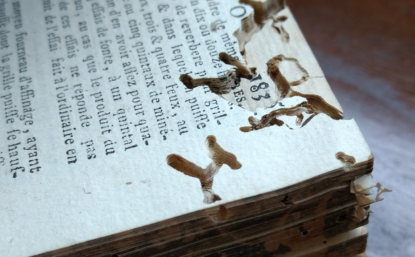
Books carry traces of where they’ve been. The history of the rare books collection’s newest addition, Benedikt Hermann’s Über die allgemeinen Eigenschaften des Kupfers (Leipzig, 1812), is hinted at even on its title page.

Read More ›

Posted In: History

The Three Best Things About This Week’s ACS Meeting

The semiannual ACS national meeting is in Denver this week. Thousands of chemists, chemical engineers, and assorted hangers-on gathered in the mile high city to learn the newest results, enjoy each other’s company, and check out new offerings in the trade show exposition. Never mind that the economy is still sluggish and even showing signs of slipping backwards—it takes worse than this to dampen the enthusiasm of the gathered scientific community.

Read More ›

Posted In: Education

Today's Magic Bullet

102 years ago today, Paul Ehrlich developed a chemical compound to effectively treat the scourge of his day: syphilis. Ehrlich’s compound, a derivative of arsenic called Salvarsan, was also the first successful chemotherapeutic agent. But the miracle drug, which Ehrlich called his “magic bullet,” was not without its problems.

Read More ›

Posted In: History | Technology

Color, Cut, Clarity, Carat…and Carbon

Though I’ve been staring at my stunningly sparkly diamond engagement ring for just over two months now, I’m still wondering where it came from. I don’t mean blood diamonds—my natural, mined stone is certified conflict-free. I mean where it originally came from and how it was made. As a lover of chemistry I see my diamond for what it really is: carbon.

Read More ›

Posted In: Technology